
Finasteride Prescription NYC: Stop Hair Thinning at the Source

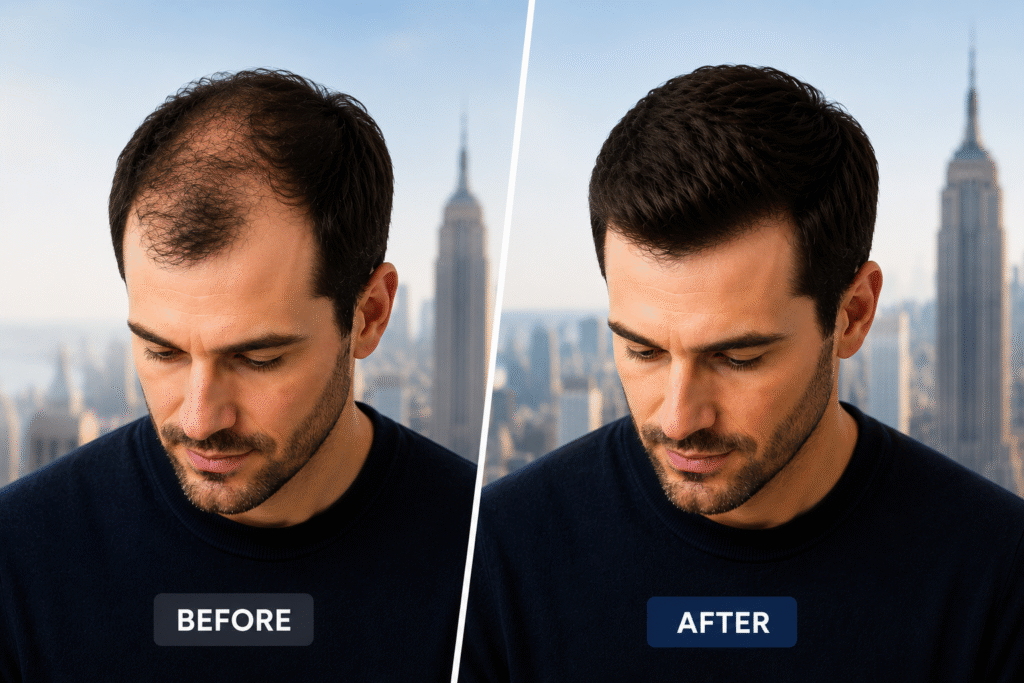
Finasteride is an FDA-approved oral medication that treats male pattern hair loss by blocking DHT, the hormone responsible for shrinking hair follicles. Taken as a 1 mg daily pill, clinical trials show 86% of men maintained or increased their hair after 12 months of treatment. In NYC, a board-certified dermatologist like Dr. Dele-Michael can evaluate whether finasteride is right for you and build a personalized hair restoration plan.
Noticing more hair in the shower drain than usual? Finding your part getting wider? Hair thinning is remarkably common, and for many people, it starts earlier than expected. Androgenetic alopecia (the clinical term for pattern hair loss) affects up to 50% of men by age 50 and up to 80% by age 80, according to the International Society of Hair Restoration Surgery. Women aren’t spared either: up to 50% will experience some degree of androgenetic alopecia in their lifetime.
For decades, the options for addressing hair loss felt limited. Topical treatments helped some. Surgery was invasive. But one prescription medication changed the conversation: finasteride. Approved by the FDA for male pattern hair loss in 1997, finasteride works at the hormonal root of the problem. Not just on the surface.
This guide covers everything you need to know about finasteride: how it works, what results to realistically expect, who it’s right for, and how a specialist like Dr. Dele-Michael at her NYC dermatology practice can guide you through the process with precision and care.
What Is Androgenetic Alopecia and Why Is It So Common?
Androgenetic alopecia is the most common form of hair loss in both men and women. The name gives away its origins: it’s driven by androgens (hormones) and genetics.
In genetically susceptible individuals, a hormone called dihydrotestosterone (DHT) binds to receptors in the hair follicle. Over time, DHT causes follicles to shrink and produce thinner, shorter hairs a process known as miniaturization. Eventually, affected follicles stop producing hair entirely.
For men, this typically begins at the temples or crown and progresses outward. For women, the pattern is usually more diffuse a widening part or overall thinning across the top of the scalp. While the condition is not medically dangerous, the psychological impact can be significant. Studies consistently link hair loss to reduced self-esteem, anxiety, and lowered quality of life.
The earlier the intervention, the better the outcome. That’s where finasteride comes in.
How Does Finasteride Work to Stop Hair Loss?
Finasteride is a 5-alpha-reductase inhibitor. That’s the enzyme responsible for converting testosterone into DHT. By blocking this conversion, finasteride reduces DHT concentrations in the serum by up to 70% and in the scalp by up to 60%, according to DermNet.
Less DHT means less follicle damage. Miniaturization slows. Some follicles that were beginning to shrink recover. New hair growth becomes possible in areas where follicles are still active.
It’s worth understanding what finasteride does not do: it doesn’t block testosterone directly, doesn’t affect hair follicles that are completely dormant, and doesn’t work on completely bald areas where follicles are no longer viable. This is why starting treatment early—before significant hair loss has occurred produces the best results.
Finasteride is taken orally, once daily at 1 mg. It can be taken with or without food, at any time of day. Consistency matters more than timing.
What Results Can You Realistically Expect From Finasteride?
Patience is part of the process. Most patients don’t notice a difference in the first few weeks—and shouldn’t expect to. According to NYU Langone Health, finasteride typically starts working after about four months, with significant hair growth potentially taking up to a year to become visible.
The clinical data, however, is encouraging. In three large, multi-center, placebo-controlled studies of 1,879 men with mild-to-moderate male pattern hair loss (cited by DermNet):
- 86% of men treated with finasteride maintained or showed an increase in hair count after 12 months
- Only 14% of men on finasteride experienced further hair loss, compared to 58% of men on placebo
- Long-term use data suggests finasteride halts hair loss or promotes regrowth in 9 out of 10 men taking it consistently
The catch? These benefits are ongoing, not permanent. If you stop taking finasteride, DHT levels return to normal within approximately 14 days (according to NIH StatPearls), and hair loss typically resumes within 12 months of discontinuation. For most patients, finasteride is a long-term commitment not a short-term fix.
What Are the Side Effects and Who Should Not Take Finasteride?
Finasteride is generally well-tolerated. In clinical trials, most men reported no serious side effects. That said, it’s important to understand the full picture before starting any prescription medication.
Reported side effects include:
- Decreased libido (1.8% of finasteride patients vs. 1.3% on placebo)
- Erectile dysfunction (1.3% vs. 0.7% on placebo)
- Decreased ejaculatory volume (0.8% vs. 0.4% on placebo)
- Gynecomastia (breast tissue enlargement) in rare cases
Most of these side effects resolved when patients discontinued treatment and in some cases, even in those who chose to continue.
Finasteride is contraindicated in:
- Pregnant women or women of childbearing age: Finasteride is classified as Pregnancy Category X. It can cause abnormalities in the external genitalia of a male fetus and must not be handled by pregnant women in crushed or broken form.
- Children: Safety and efficacy have not been established in pediatric patients.
- Individuals with hypersensitivity to any component of the formulation.
A rare but discussed concern is post-finasteride syndrome (PFS), which refers to the continuation of side effects after discontinuing therapy. Investigational studies are underway to better characterize this condition. Anyone experiencing persistent symptoms should consult their prescribing physician immediately.
This is precisely why a consultation with a board-certified dermatologist, not an online pharmacy or telehealth shortcut, is the responsible first step.
Finasteride Compared to Other Hair Restoration
Finasteride is one tool in a broader toolkit. Depending on the extent of your hair loss, your goals, and your overall health, a specialist might recommend finasteride alone, in combination with other treatments, or as part of a comprehensive hair restoration plan.
Here’s how finasteride compares to other commonly used approaches:
Finasteride vs. Minoxidil
Minoxidil is a topical (or oral) medication that stimulates hair growth and is available over the counter. Finasteride, by contrast, works at the hormonal level, addressing the root cause rather than just stimulating the follicle. Both can be used together. DermNet notes that many practitioners have safely combined the two, and patients switching between treatments are advised to overlap by six months to avoid a gap in coverage.
Finasteride vs. PRP (Platelet-Rich Plasma) Therapy
PRP therapy uses your own blood’s concentrated growth factors to reinvigorate thinning follicles. At Dr. Dele-Michael’s NYC practice, PRP hair restoration starts at $600 and is particularly effective for male and female pattern hair loss. PRP is non-pharmacological and doesn’t carry the hormonal effects of finasteride—making it a strong option for women or for men who prefer to avoid oral medications.
Finasteride vs. NeoGraft Hair Restoration
NeoGraft is a precise transplant technique that permanently relocates hair follicles from a donor area to thinning regions without the linear scarring of traditional strip harvesting. Starting at $2,500, NeoGraft is best suited for those with more advanced hair loss and for skin of color patients, a key focus of Dr. Dele-Michael’s practice. Finasteride can support NeoGraft outcomes by preserving existing hair around the transplant site.
Finasteride vs. Low-Level Laser Light Therapy (LLLT)
Clinicians use LLLT to deliver visible light that invigorates hair follicles, and they often recommend it after procedures or as a standalone treatment for early-stage thinning.
Available at Dr. Dele-Michael’s practice starting at $600, it’s non-invasive and works well in combination with pharmacological options like finasteride.
The right approach depends on your specific pattern of loss, medical history, and goals. A thorough evaluation by a board-certified dermatologist ensures you’re not guessing.
Why See Dr. Dele-Michael for a Finasteride Prescription in NYC?
Not all hair loss is the same, and not all hair responds to the same treatment. Researchers have historically under-researched and underserved patients with skin and hair of colour, making this especially relevant for these individuals.
Dr. Dele-Michael has spent more than a decade addressing this gap. As a board-certified African American dermatologist based in New York, she has built her practice on a foundational principle: inclusive, expert-led beauty care that truly accounts for the full spectrum of skin tones and hair textures.
Getting a finasteride prescription in NYC isn’t difficult; telehealth platforms can issue one in minutes. But getting the right prescription, for the right reason, with ongoing monitoring and an integrated treatment plan? That requires a specialist who can assess your hair-loss pattern, rule out other causes (such as nutritional deficiencies, scalp conditions, or hormonal imbalances), and determine whether finasteride is appropriate for your specific situation.
At the practice of Dr. Dele-Michael, the team provides a full range of hair restoration services, including prescription medications, PRP, LLLT, Eurothreads, and NeoGraft, and tailors every recommendation to what will actually work for each patient rather than relying on a one-size-fits-all pro.
Take the First Step Toward Thicker, Healthier Hair
Hair thinning is a process that starts quietly and accelerates over time. The sooner you act, the more options you have. Clinical studies have demonstrated finasteride’s effectiveness over three decades, but patients achieve the best results when they start treatment before hair follicles become irreversibly damaged.
If you’re experiencing hair thinning in New York and want to explore whether a finasteride prescription is right for you, schedule a consultation with Dr. Dele-Michael at her NYC dermatology practice. A personalized evaluation, expert guidance on all available treatments, and a plan built around your hair, your history, and your goals.
– Book your consultation at drdelemichael.com
Frequently Asked Questions
Can I get a prescription for finasteride in NYC without seeing a dermatologist in person?
Telehealth services can technically issue a finasteride prescription remotely. However, seeing a board-certified dermatologist in person like Dr. Dele-Michael in NYC ensures an accurate diagnosis, rules out other causes of hair loss, and enables ongoing monitoring. An in-person evaluation is the safest and most effective starting point.
How long does it take for finasteride to show results?
According to NYU Langone Health, finasteride typically begins working after about four months, but significant hair regrowth may take up to 12 months. Consistency is critical skipping doses or discontinuing treatment early will reduce effectiveness.
Is finasteride effective for women with hair thinning?
The FDA approved finasteride only for the treatment of male pattern hair loss. Doctors occasionally prescribe it off-label for postmenopausal women, but they strictly avoid prescribing it to women who are pregnant or may become pregnant because of the risk of fetal harm. Women experiencing hair thinning may benefit more from PRP therapy or other treatments available at Dr. Dele-Michael’s NYC practice.
What happens if I stop taking finasteride?
If you stop taking finasteride, DHT levels return to normal within approximately 14 days, and hair loss typically resumes. According to NIH StatPearls, a full reversal of hair count improvements occurs within 12 months of discontinuation. Doctors generally consider finasteride a long-term treatment.
What is the standard finasteride dosage for hair loss?
The FDA-approved dose for androgenetic alopecia is 1 mg once daily, taken orally with or without food. Doctors prescribe the 5 mg dose for benign prostatic hyperplasia. A dermatologist will confirm the correct dosage for your specific situation.
Can finasteride be combined with other hair restoration treatments?
Yes. Doctors can safely combine finasteride with minoxidil, PRP therapy, and LLLT, and often recommend these as supportive treatments following NeoGraft hair transplantation. A specialist like Dr. Dele-Michael can design a comprehensive hair restoration plan that combines the most appropriate treatments for your individual needs.
Is finasteride safe for people with skin of color?
Yes. Finasteride’s mechanism of inhibiting DHT at the hormonal level is not affected by skin tone or hair texture. However, hair restoration decisions for patients with skin of color benefit from the expertise of a specialist familiar with the specific patterns and considerations for diverse hair types. Dr. Dele-Michael’s practice in NYC specializes in exactly this.